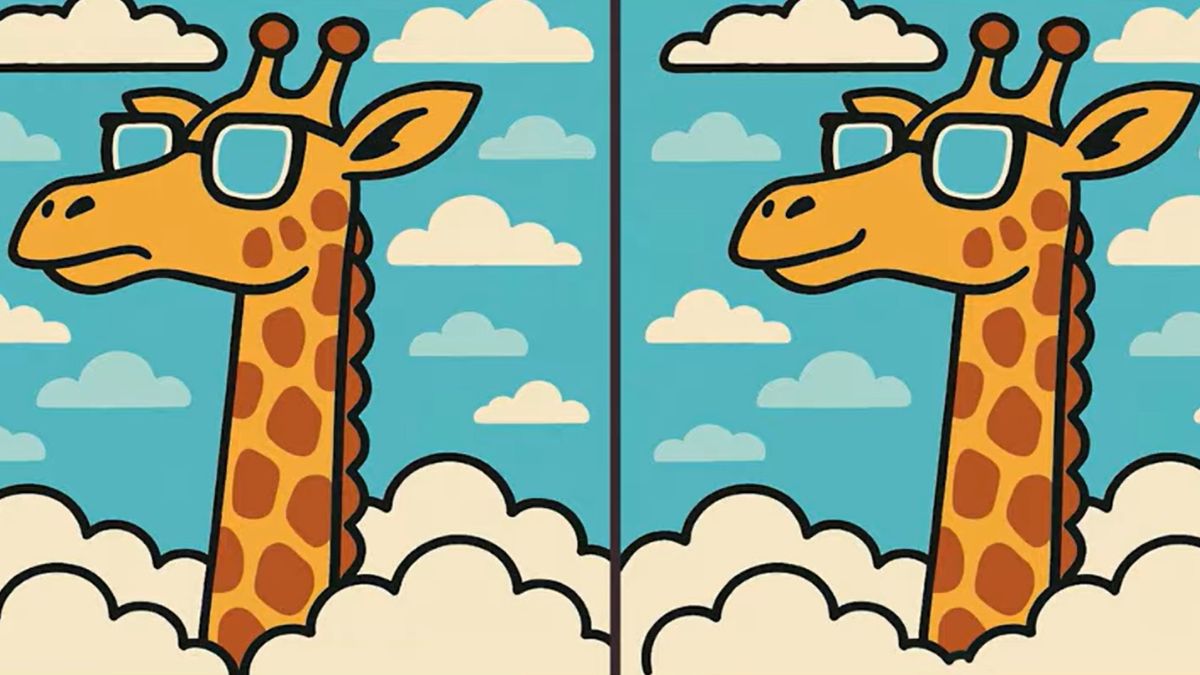
Have you ever thought a giraffe could wear glasses and challenge your brain at the same time? It may sound unusual, but that is exactly what today’s viral visual puzzle offers. The “Spot the 3 Differences in Giraffe Wearing Glasses” challenge is not only fun but also a true test of your observation skills. With only 23 seconds on the clock, this activity is designed to push your attention to detail, your memory, and your quick-thinking ability, all while entertaining you.
The Fascination Behind Spot the Difference Games
Spot the difference puzzles have been around for decades, appearing in newspapers, magazines, and now, online platforms. Their popularity lies in their simplicity combined with a subtle challenge. Players are presented with two seemingly identical images and are asked to find the small differences between them. While the activity may sound simple, it often reveals how much—or how little—your brain notices.
When a giraffe wearing glasses enters the scene, the challenge becomes even more engaging. Not only does it add humor and novelty, but it also introduces visual complexity. Glasses on a giraffe are a quirky twist that makes the differences harder to detect, forcing you to pay closer attention. It’s this mix of fun and cognitive exercise that makes the challenge addictive.
Why the 23-Second Time Limit Makes It Thrilling
Most people underestimate the power of a short time limit. At 23 seconds, the brain is pushed into hyper-focus mode. Your eyes scan, your mind analyzes, and your attention to detail must be precise. The countdown creates a sense of urgency, making the puzzle feel less like a casual game and more like a mini brain competition.
This fast-paced approach activates your cognitive speed and sharpens your reflexes. Studies in cognitive science suggest that time-based challenges can enhance focus, reaction time, and mental agility. So, while it may feel like you’re simply having fun spotting differences, you are unknowingly giving your brain a rigorous workout.
The Charm of a Giraffe Wearing Glasses
The visual choice of a giraffe wearing glasses is more than just a random decision. Giraffes are already unique animals with their long necks, distinctive patterns, and gentle expressions. Adding glasses introduces humor and relatability, transforming an ordinary animal into a character with personality.
This anthropomorphism—the act of giving human traits to animals—plays a significant role in engagement. People naturally feel drawn to animals that exhibit human-like features. When the giraffe appears with glasses, it sparks curiosity and amusement, making players more motivated to complete the challenge. The puzzle becomes not just a brain exercise but a visual story, engaging multiple senses and emotions.
Techniques to Spot Differences Quickly
Spotting differences under pressure requires a combination of strategy and focus. First, scan the entire image slowly before zeroing in on details. Look for color variations, misplaced patterns, or missing elements. In the case of a giraffe wearing glasses, pay special attention to its glasses, facial expressions, and body patterns, as these areas are often where designers place the subtle differences.
Second, don’t rely solely on your memory. Use a systematic approach—start from the top-left corner and move across the image in a grid-like pattern. This reduces the chances of missing hidden differences.
Lastly, stay calm. Panic is the enemy of observation. Even though the 23-second timer is ticking, keeping a composed mind improves accuracy. The combination of calmness, systematic scanning, and attention to detail is key to beating the challenge.
Why These Puzzles Are Good for Brain Health
Beyond entertainment, spot-the-difference puzzles offer significant cognitive benefits. They stimulate the visual cortex and improve attention to detail. For children, they enhance focus, concentration, and patience. For adults, they serve as mental exercises that can help maintain brain sharpness over time.
Research has shown that engaging in regular visual puzzles can improve problem-solving skills and even reduce cognitive decline in older adults. Challenges like spotting differences in a giraffe wearing glasses might appear simple, but they exercise your brain in ways that are surprisingly effective.
The Social Fun Factor
In the age of social media, challenges like this have a social dimension. People love sharing puzzles, competing with friends, and boasting about completing them in record time. Posting your time for the 23-second giraffe puzzle can spark conversations, friendly competitions, and online engagement.
This social aspect adds another layer of fun. You’re not just solving a puzzle for yourself; you’re participating in a shared experience. The quirky image of a giraffe wearing glasses makes it more memorable and shareable, giving it viral potential.
Strategies for Beginners
If you’re new to spot-the-difference puzzles, starting with a relaxed approach helps. Don’t worry about beating the 23-second challenge immediately. Take your time to observe patterns, colors, and details. Notice how small alterations—like a shifted ear or missing spot—stand out once your eyes are trained.
Once comfortable, gradually reduce the time limit. Set small goals, like spotting all differences in 60 seconds, then 40, and eventually attempt the 23-second challenge. This gradual approach builds skill without causing frustration.
Advanced Tactics for Experienced Players
Experienced players often employ advanced strategies. One is to focus on symmetry and repetition. Designers often use subtle asymmetries to create differences. In the giraffe puzzle, for example, one side of the glasses might be slightly tilted, or one spot on its neck might differ in size. By mentally segmenting the image into areas of interest, you can identify discrepancies faster.
Another tactic is to use peripheral vision. Quick scanning with a broad visual sweep allows you to catch differences without staring at one spot for too long. Combining peripheral scanning with focused observation is what separates casual players from high scorers.
The Psychological Reward of Completing the Challenge
There’s a deep sense of satisfaction when you finally spot all three differences within the 23-second time frame. The human brain rewards accomplishment with a surge of dopamine, making you feel proud and accomplished. This positive reinforcement encourages repeated play, and the humorous factor of the giraffe wearing glasses enhances the experience.
It’s more than a simple puzzle—it’s a mini victory that stimulates your brain and emotions simultaneously. Each successful attempt reinforces confidence, observation skills, and mental agility.
Conclusion: Why You Should Try It Today
Spotting the 3 differences in a giraffe wearing glasses may seem like a small activity, but it’s a perfect blend of fun, challenge, and brain exercise. Whether you’re a casual player, a child developing focus, or an adult looking for a quick cognitive boost, this 23-second challenge offers something for everyone.
Not only does it sharpen your observation skills, but it also engages your sense of humor, patience, and strategy. The quirky image of a giraffe with glasses adds character and fun, making the puzzle more than just a game—it becomes an experience.
So why wait? Take on the challenge today, test your observation skills, and see if you can spot all three differences before the timer runs out. Once you succeed, share it with friends and family and invite them to experience the fun. You might be surprised at how addictive a little giraffe puzzle can become!
FAQs
Q1: What is the “Spot the 3 Differences in Giraffe Wearing Glasses” challenge?
A: It’s a visual puzzle where you find three differences between two images of a giraffe wearing glasses within 23 seconds.
Q2: How many differences do I need to find?
A: There are three differences to spot.
Q3: How much time do I get to complete the challenge?
A. You have 23 seconds to spot all the differences.